In His infinite wisdom, God has given to mankind a marvellous recipe for world peace. The following are some of its main ingredients:
| • |
Love your enemies. (Matthew 5:44) |
| • |
Do good to those who hate you. (Luke 6:27) |
| • |
Be kind to the ungrateful and wicked. (Luke 6:35) |
| • |
Repay evil with blessing. (1 Peter 3:9) |
| • |
Give food and water to those who dislike you. (Proverbs 25:21) |
| • |
Pray for those who persecute you. (Matthew 5:44) |
| • |
Bless those who curse you. (Luke 6:27) |
| • |
Rather be wronged than take a double-dealer to court. (1 Corinthians 6:7) |
Because these are critical components in God's plan for peace, it follows that these are also critical features in the character profile of God's peacemakers. These are the extraordinary people, . . .
| • |
Who always find a valid reason for another's mistakes, |
| • |
Who always remember their own mistakes when others err, |
| • |
Who always see the erring as Jesus saw them . . . |
These are the extraordinary people who have risen above the slights, the rebuffs and the annoyances of this world and who, by their meekness, give us convincing evidence that it is indeed possible to love our enemies, to do good to those who hate us, and to be kind to the ungrateful and wicked.
With these challenging thoughts in mind, let us now consider what you and I can do to ensure that we are numbered amongst those who so reflect the character of the Lamb?
Our first clue is found in the words of the Lamb Himself.
"By their fruit you will recognize them." (Matthew 7:16)
Fruit? What exactly does Jesus mean when He refers to "fruit"?
Paul answers this question in the book of Galatians. He tells us that . . .
"The fruit of the Spirit is love, joy, peace, patience, kindness, goodness, faithfulness, gentleness and self-control." (Galatians 5:22)
These are the good fruits by which we should be recognized, and these are the characteristics of a peculiar group of people who find in their hearts an irresistible impulse to give food and water to those who dislike them, to pray for those who persecute them, and to bless those who curse them.
Once again, therefore, let us pose the question:
What can you and I do to become more fruitful?
Should we stand in front of the mirror every day and try and persuade ourselves to love our enemies? Is there some or other ritual that will enable us to do good to those who hate us? Jeremiah assures us that this approach cannot work.
"Can the Ethiopian change his skin or the leopard its spots? Neither can you do good who are accustomed to doing evil." (Jeremiah 13:23)
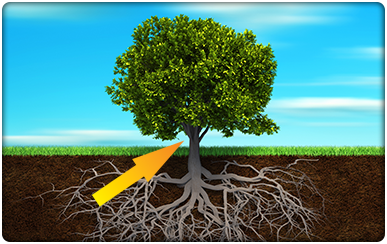
Nevertheless, the good news is that God has given us all of the answers in nature. If we understand the part that the farmer plays in the cultivation of fruit on a tree, we will have no doubt as to the factors that bring forth the fruits of the Spirit in our lives.
So what is the part that the farmer plays in the cultivation of fruit?
The first lesson, one with which any fruit farmer will agree, is that if you want a tree to bear good fruit, your primary focus must not be on the fruit, but on the tree.
Jesus teaches this very principle in the book of Matthew where He states, . . .
"Make a tree good and its fruit will be good, or make a tree bad and its fruit will be bad." (Matthew 12:33)
This, in fact, is a hard and fast rule for, according to the Master Teacher, . . .
"No good tree bears bad fruit, nor does a bad tree bear good fruit." (Luke 6:43)
This statement of truth brings to mind yet another important question:
What part does the farmer play in making "good trees?"
Scripture again gives us the answer. According to Paul . . .
"If the root is holy, so are the branches." (Romans 11:16)
To make good fruit, therefore, we need to make a good tree, and in order to make good trees, we have to make good roots.
Yet, here again, this horticultural fact demands that we ask another vital question:
If good roots make fruitful trees, just what part can the farmer
play in making "good" roots?
In the parable of the wise gardener, Jesus gives us the answer to this question:
"A man had a fig tree, planted in his vineyard, and he went to look for fruit on it, but did not find any. So he said to the man who took care of the vineyard, 'For three years now I've been coming to look for fruit on this fig tree and haven't found any. Cut it down! Why should it use up the soil?'
"'Sir,' the man replied, 'Leave it alone for one more year, and I'll dig around it and fertilize it. If it bears fruit next year, fine! If not, then cut it down.'" (Luke 13:6-9)
The problem, therefore, was not with the fruit, nor with the tree, nor with the branches, nor with the roots. As is so often the case with fruitless trees, the problem was not with the tree itself, but with the soil in which the tree was rooted.
As Scripture repeatedly confirms, it is, to a large extent, the state of the soil that determines the yield of the plant:
"The soil makes the sprout come up." (Isaiah 61:11)
"All by itself the soil produces corn - first the stalk, then the ear, then the full kernel in the ear." (Mark 4:28)
"The ground of a certain rich man produced a good crop." (Luke 12:16)
"Others, like seed sown on good soil, hear the word, accept it, and produce a crop." (Mark 4:20)
Thus the sure word of God assures us that, as a rule, if the soil is good, the roots will be good, and if the roots are good, the branches will be good, and if the branches are good, the tree will be good, and if the tree is good, the fruit will be good.
This is how it works in the temporal realm, and this is precisely how it works in the spiritual realm. If we care for the "spiritual soil" we can expect a bountiful harvest of "spiritual fruit."
The multi-trillion dollar question, of course, is this:
What is the spiritual soil?
If we can only answer this question, we will know precisely what part we are to play in the process of character transformation.
What, therefore, is the spiritual soil? We are told that . . .
"The human mind is represented by the rich soil of a garden. Unless it [the mind] shall receive proper cultivation, it will be overgrown with the weeds and briers of ignorance. The mind and heart need culture daily, and neglect will be productive of evil." (4T442.2)
It's as simple as that: The human mind is the spiritual soil that, in large measure, determines the "fruitfulness" of our lives. In other words, the state of our minds will determine the tenor of our characters.
| • |
Just as the conditioning of the soil will encourage the development of fruit on a tree, so it is that the conditioning of our minds will play a pivotal role in the development of the fruits of the Spirit in our lives. |
| • |
Just as the farmer cannot force a tree to bear fruit, so we cannot force ourselves to be loving, joyful, peace-filled, patient, kind, good, faithful, gentle and self-controlled people - but if we play our part in conditioning the soil of our minds, God will play His part in ensuring that we become fruitful Christians. |
The all-important question, therefore, is this:
Just how do we condition the soil of our minds?
The answer to this question is both simple and logical:
"The mind is built up from that upon which it feeds." (FE451.1)
In short, if we feed our minds on truth, and we shield our minds from all that is out of harmony with truth, our characters will be transformed, and the fruits of love will surely bend the branches of our spiritual tree:
"You will know the truth, and the truth will make you free." (John 8:32)
Truth, therefore, is the spiritual soil that feeds our spiritual plant.
This is incredibly amazing news indeed for it assures us that if we have been struggling to overcome our character flaws, or if we have been struggling with our appetites, or with our spiritual experience, or if we have been having difficulty loving individuals who are getting under our skin, then we can cease our vain singlehanded efforts to overcome these human weaknesses, and rather start paying more careful attention to that which feeds our minds.
While it is true that we cannot change our characters, we can change the things that we are reading, looking at, listening to, and thinking about – and we can change certain friendships. It is most certainly in our power to change the "soil" of the mind, and this good soil, aided by the Holy Spirit, will bring forth the fruits of love in our lives.
This is precisely what Paul is driving at in the book of Philippians:
"Whatever is true, whatever is noble, whatever is right, whatever is pure, whatever is lovely, whatever is admirable - if anything is excellent or praiseworthy - think about such things." (Philippians 4:8)
If we choose to change the soil of our minds by beholding the good, and by refusing to behold all that is bad, we can rest assured that the Holy Spirit will endorse our efforts and that He will work a miraculous transformation in our characters.
As such, we need to keep ourselves ever reminded that . . .
"Our religious experience is of exactly the same quality as the food we give our minds." (SpM57)
This means that if we behold the mad, the sad, and the bad, we will most surely become mad, sad and bad – regardless of our profession. But if we guard our minds from evil, and we feed on the holy and the pure and the uplifting, the good side of our natures will gradually gain the ascendancy over the evil side of our natures, and we will soon find that we will gain the victory over those things that may long have held us in bondage.
"Let us, then, feed upon Christ. Let the mind dwell upon the subjects that are of eternal consequence. If we will feed upon Him we shall become new creatures in Christ Jesus . . . The power of Christ will work to sanctify every part of the being, diffusing life, activity, and soundness through the whole, and developing spiritual efficiency." (RH08-13-01; TMK106.5)
"When one turns away from human imperfections to behold Jesus, a divine transformation takes place in the character. The Spirit of Christ working upon the heart conforms it to His image. Then let it be your effort to lift up Jesus. Let the mind's eye be directed to 'the Lamb of God, which taketh away the sin of the world.'" (COL250.3)
"There is but one way to heaven, and it requires the consecration of all the powers of the mind, of all the affection of the soul, to Christ, by whom we have peace with God." (RH, February 10, 1891 par. 10)
"Christ will perform wonderful miracles if men will but do their God-given part. In human hearts today as great a transformation may be wrought as has ever been wrought in generations past." (COL236.1)
In the light of the foregoing, we conclude that the Christian warfare is not so much a direct battle against sin as it is a proactive and ongoing endeavor (a) to shield the mind from every polluting influence, and (b) to saturate the mind in all that is true, noble, right, pure, lovely, admirable, excellent and praiseworthy.
"The mind must be constantly restrained and guarded. It must be given as food that only which will strengthen the religious experience." (MM89.4)
"Although we are in a world teeming with moral corruption, we have no need to gather to our souls the disgusting pollutions of earth. We may refuse the evil. We may choose the good. We may gather to our souls the precious, the pure, the heavenly; we may put into our character-building solid timber that will make a fit temple for the indwelling of the Holy Spirit." (ST, June 29, 1888 par. 11)
This, then, is how we root ourselves in God's love; how we abide in the Vine; how we eat the flesh and the blood of the Lamb; how we partake of the bread and the water of life; how we become lights unto the world, how we become the salt of the earth; and this is our sure reward when we "dwell in the secret place of the Most High" and we "abide under the shadow of the Almighty." (Psalm 91:1)
The sure word of inspiration assures as that we are drawing near to the time when the knowledge of the love of God will fill the earth as the waters fill the sea. Soon an unprecedented revival will sweep the world, and Scripture tells us precisely what it is that will spawn this extraordinary and final revival.
"Once more a remnant of the house of Judah (God's people) will take root below and bear fruit above." (2 Kings 19:30)
"In days to come Jacob will take root, Israel (God's people) will bud and blossom and fill all the world with fruit." (Isaiah 27:6)
May God help us to play our part.
"But we all, with open face beholding as in a glass the glory [character] of the Lord, are changed into the same image from glory to glory, even as by the Spirit of the Lord." (2 Corinthians 3:18 KJV)
This being the case, "let us run with endurance the race that is set before us, fixing our eyes on Jesus, the author and perfecter of faith." (Hebrews 12:1-2)
A Meditational Adventure: Having considered the importance of the soil in the production of fruit, we draw your attention to some of the other factors that influence plant growth - such as the sun, water, air, and wind – and we invite you to prayerfully contemplate the spiritual counterparts to each of these factors.
The Power For Change: Whereas this document focuses on the principles that govern the changing of our characters, the new believer may find within his heart a strange reluctance to put these principles into practice. This all changes, however, as we develop a relationship with God, and as we gain a better understanding of the gospel of His grace.
To learn more about God and about His grace, please visit the features on this website entitled
The Secret Place – Your Hiding Place in a Troubled World and
My Escape from Death Row.